Aurora

Nature’s most beautiful light show
Have you ever wondered how these beautiful auroras, also known as the Northern Lights, are formed? Why do they occur mainly near Earth’s polar regions?
The answer brings us all the way back to the Sun. Contrary to what we often imagine, the Sun is not simply a giant ball of fire. Instead, it is made up of an extremely hot state of matter known as plasma, where electrons and atomic nuclei move freely around one another.
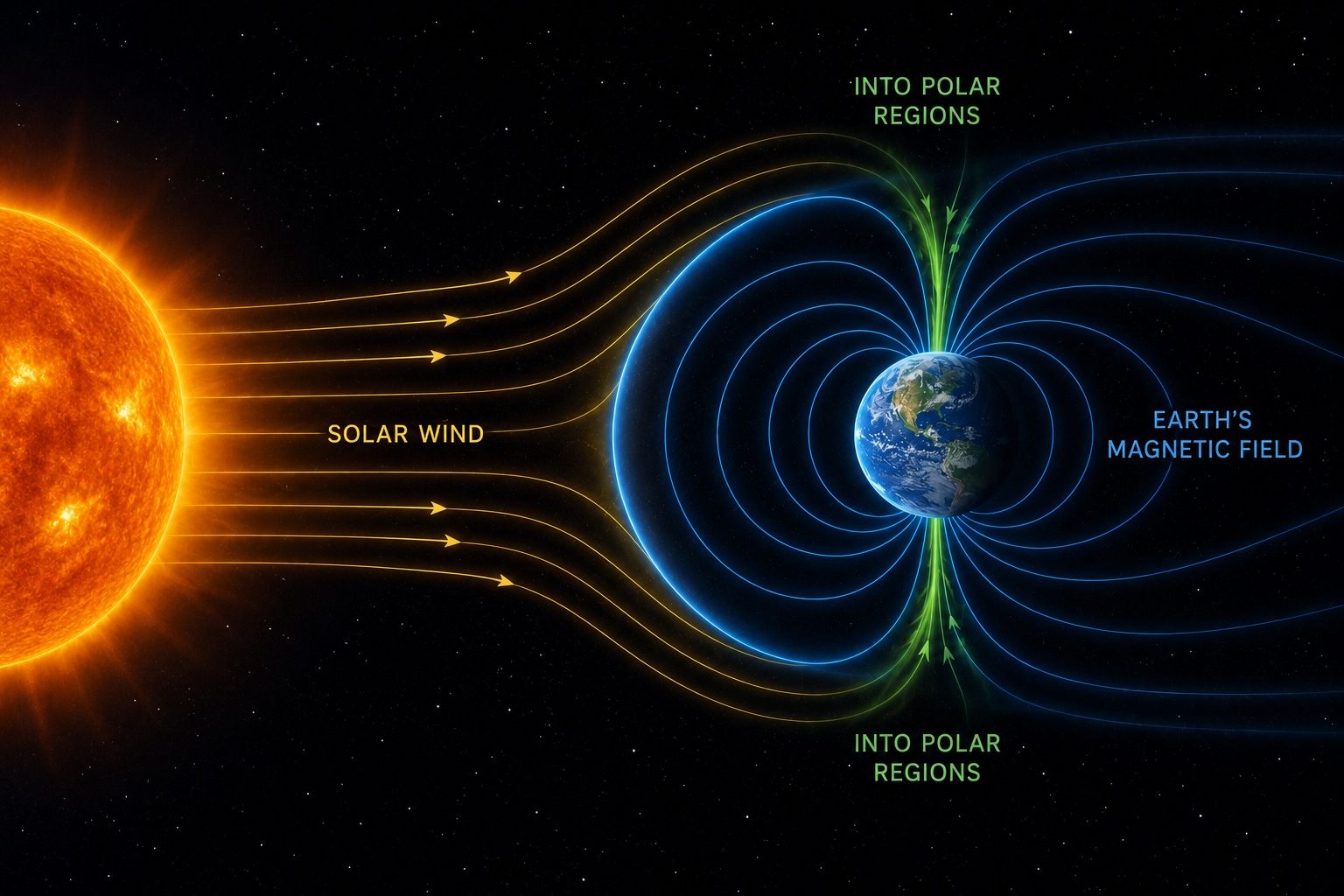
The Sun’s plasma is constantly shaped by its powerful magnetic field. Occasionally, some of this plasma escapes the Sun, releasing streams of charged particles into space. This continuous flow of charged particles is known as the solar wind.
When the solar wind reaches Earth, most of these charged particles are deflected by Earth’s magnetic field. However, some of them become trapped and are guided along the magnetic field lines toward the North and South Poles.
As these particles enter Earth’s upper atmosphere, they collide with gases such as oxygen and nitrogen. These collisions transfer energy to the atmospheric gases, causing them to glow and emit light. The result is the breathtaking display we know as an aurora.
The colors of the aurora depend on which gases are involved in the collisions and the altitude at which they occur. Oxygen can produce green or red auroras, while nitrogen can produce blue or purple hues. Different interactions release different wavelengths of light, creating the spectacular variety of colors we see dancing across the night sky.
In a world full of sunsets, be the aurora.
Keywords
- Plasma: Plasma is superheated matter – so hot that the electrons are ripped away from the atoms forming an ionized gas. It comprises over 99% of the visible universe. Plasma is often called “the fourth state of matter,” along with solid, liquid and gas. Just as a liquid will boil, changing into a gas when energy is added, heating a gas will form a plasma.
- Ionosphere: The Ionosphere is part of Earth’s upper atmosphere, between 80 and about 600 km where Extreme UltraViolet (EUV) and x-ray solar radiation ionizes the atoms and molecules thus creating a layer of electrons. the ionosphere is important because it reflects and modifies radio waves used for communication and navigation.
- Wavelength: Wavelength is the distance between identical points (adjacent crests) in the adjacent cycles of a waveform signal propagated in space or along a wire. Wavelength is inversely related to frequency, which refers to the number of wave cycles per second. The higher the frequency of the signal, the shorter the wavelength.
Images