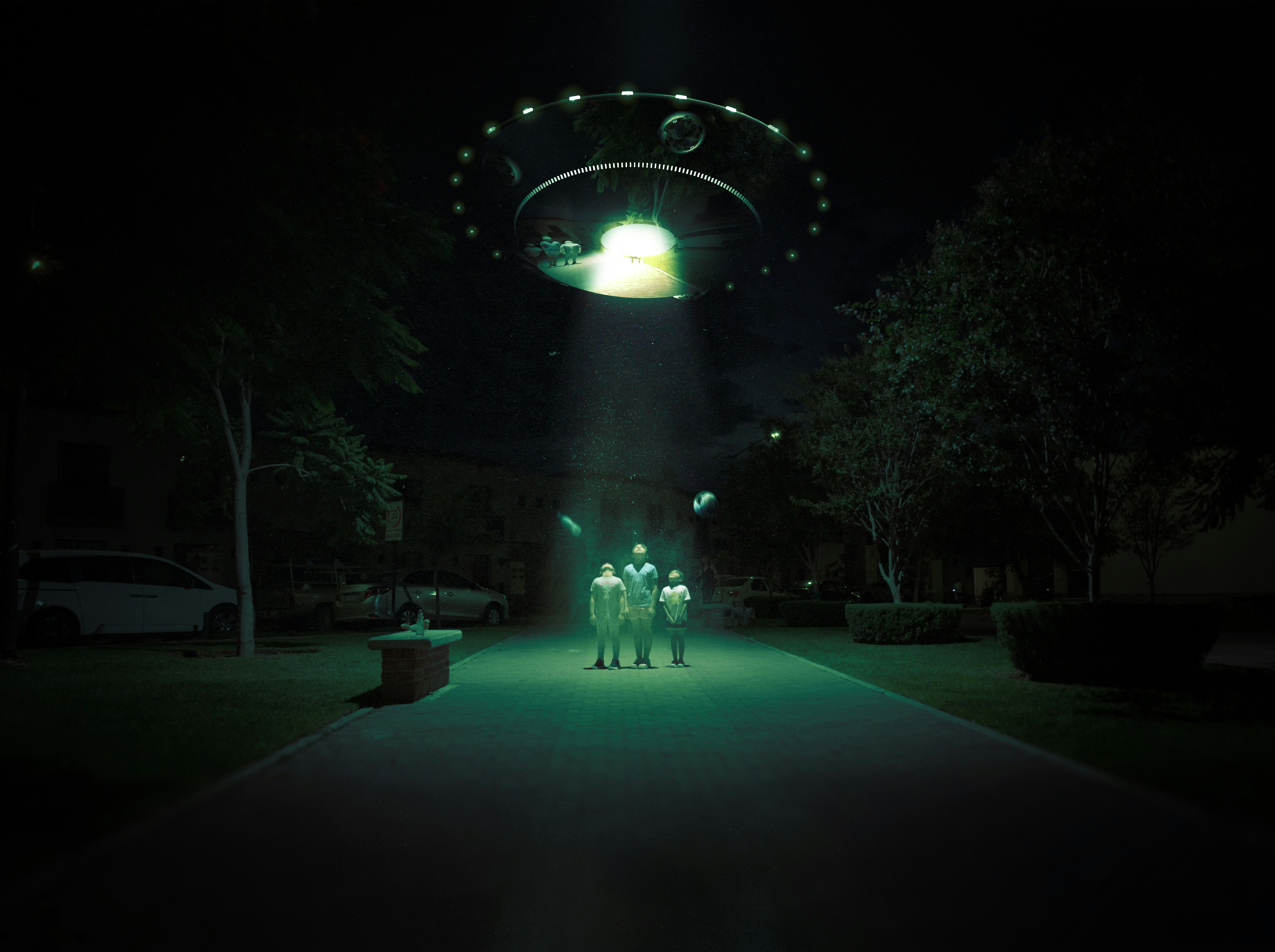
Fermi Paradox

Are we alone?
Have you ever looked up at the night sky and wondered: are we alone in the universe? If intelligent extraterrestrial life is likely to exist, then why haven’t we found any evidence of it? The contradiction between the high probability of extraterrestrial civilizations and the lack of observational evidence is known as the Fermi Paradox.
The Milky Way galaxy alone contains roughly 100 to 400 billion stars. Among them, billions may be Sun-like stars. Many of these stars are believed to host planets, and a fraction of those planets may lie within the so-called habitable zone, where conditions could allow liquid water to exist.
Even with conservative estimates, this suggests an enormous number of potentially habitable worlds. Over the history of the Milky Way, which is billions of years older than Earth, there may have been countless opportunities for life to emerge and evolve.
So where is everyone? There are many proposed explanations for the Fermi Paradox.
One possibility is the Rare Earth hypothesis, which suggests that the combination of conditions required for complex life to evolve may be extremely unlikely. In this view, Earth may be an exceptional case, and intelligent life could be far rarer than we expect.
Another possibility is that life exists, but we are simply not detecting it. We may not be using the right methods, or civilizations may be too far away for their signals to have reached us.
A more unsettling idea is the Great Filter hypothesis, which suggests that somewhere along the path from simple life to advanced civilization, there is a stage that is extremely difficult to pass. Civilizations may commonly destroy themselves before becoming capable of interstellar communication. If this is true, it raises a difficult question: is the Great Filter behind us, or ahead of us?
So what do you think? Are we alone, or just early?
Fun Fact
The name “Milky Way” comes from the appearance of our galaxy as a faint milky band across the sky. The term originates from the ancient Greek word galaxias, meaning “milky circle,” inspired by its hazy appearance when viewed from Earth.
Keywords
- Milky Way Galaxy: The Milky Way is the galaxy that includes our Solar System, with the name describing the galaxy’s appearance from Earth: a hazy band of light seen in the night sky formed from stars that cannot be individually distinguished by the naked eye.
- Great Filter: The Great Filter, in the context of the Fermi paradox is whatever prevents non-living matter from undergoing abiogenesis (life arising from lifelessness) in time, to expanding lasting life
Images