Schrödinger's Cat
Curiosity kills the cat
Have you ever wondered how curiosity can actually kill a cat? It’s not just a saying—it’s also tied to one of the most famous thought experiments: Schrödinger’s Cat, proposed by physicist Erwin Schrödinger.
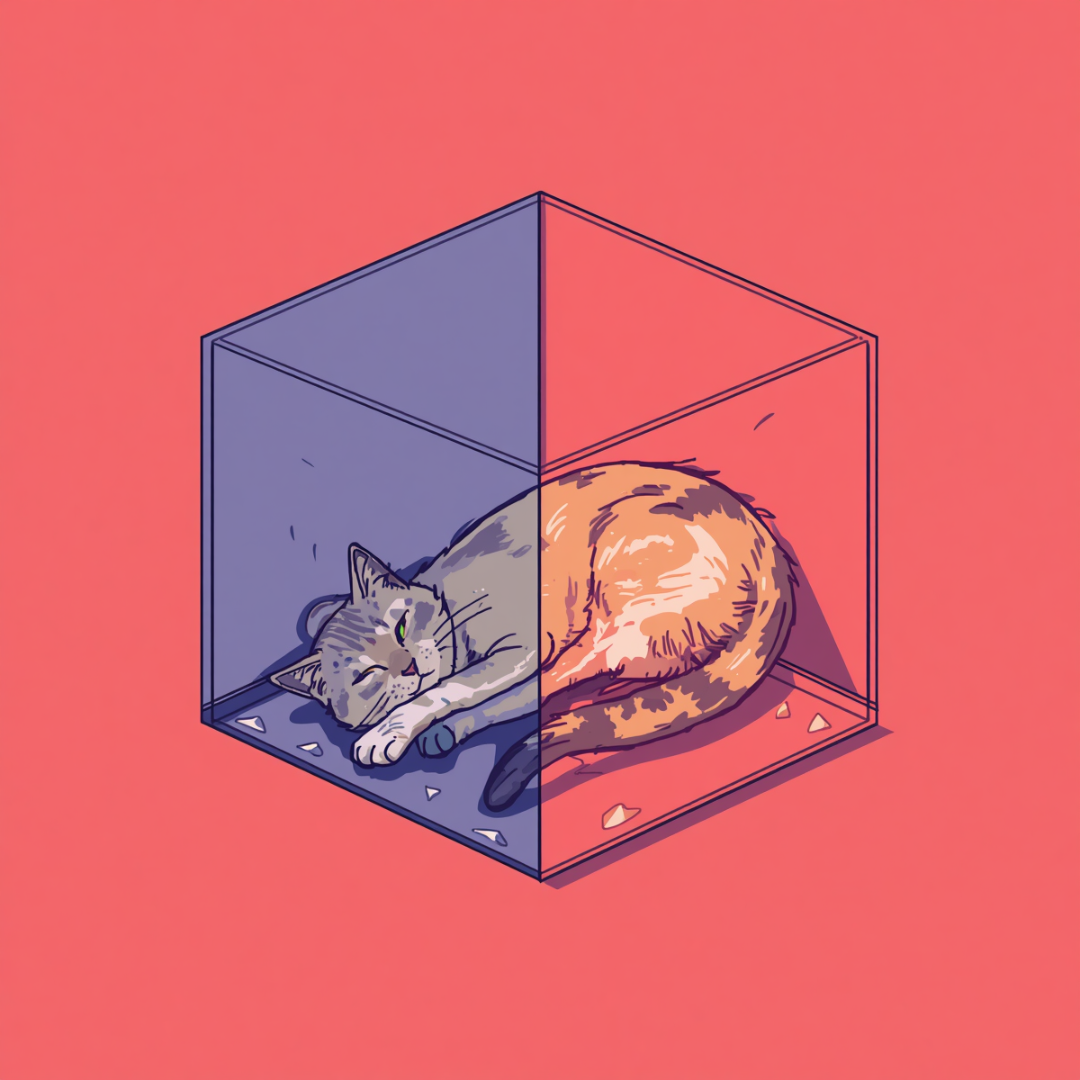
This thought experiment describes a hypothetical cat placed inside a sealed box containing a radioactive substance, a detector, and a flask of poisonous gas. If the radioactive atoms decay, the detector triggers a hammer that breaks the flask, releasing the gas and killing the cat.
Because radioactive decay is probabilistic, there is a chance that the atoms decay and a chance that they do not. Until the box is opened, we cannot know the outcome.
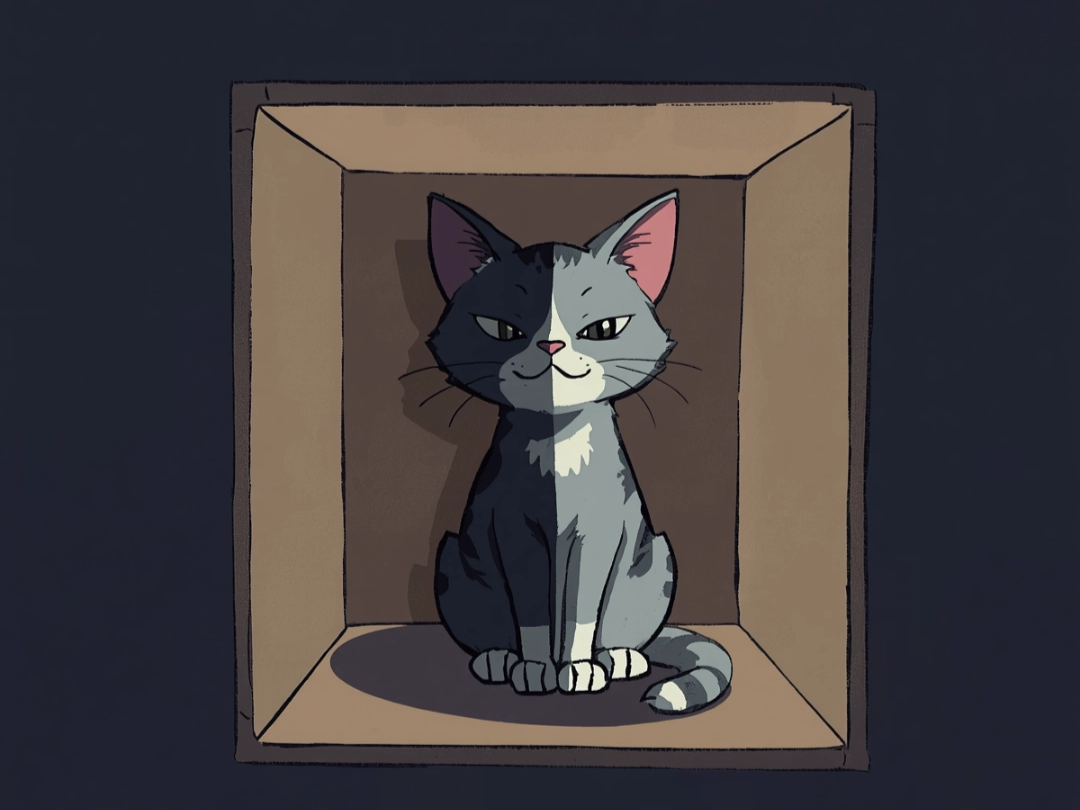
According to certain interpretations of quantum mechanics, the system can be described as a superposition of states—meaning the cat is both dead and alive at the same time, at least in theory. This idea is known as Quantum Superposition.
However, once the box is opened, the superposition appears to collapse, and we observe the cat as either dead or alive — not both.
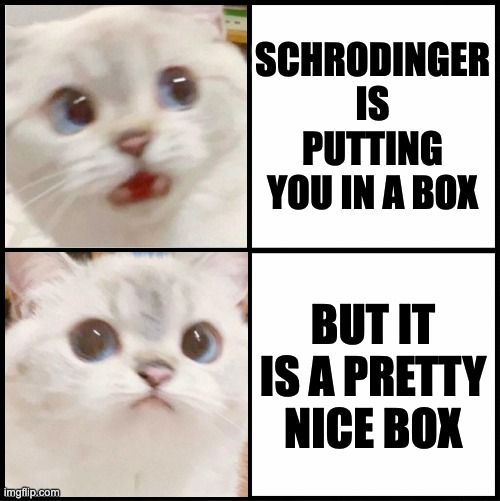
Schrödinger proposed this paradox to highlight how strange quantum mechanics becomes when applied to everyday objects. It raises deep questions about observation, measurement, and reality itself.
Curiosity makes us open the box,
but it may also kill the cat!
Keywords
Erwin Schrödinger: Erwin Rudolf Josef Alexander Schrödinger (12 August 1887 – 4 January 1961), sometimes written as Erwin Schrodinger or Erwin Schroedinger, was a Nobel Prize-winning Austrian-Irish physicist who developed a number of fundamental results in quantum theory. In popular culture, he is most known for his “Schrödinger’s cat” thought experiment.
Quantum Superposition: Quantum superposition is a fundamental principle of quantum mechanics. It states that, much like waves in classical physics, any two (or more) quantum states can be added together (“superposed”) and the result will be another valid quantum state; and conversely, that every quantum state can be represented as a sum of two or more other distinct states.
Decay: Radioactive decay is the process by which an unstable atomic nucleus loses energy by radiation. A material containing unstable nuclei is considered radioactive.
Quantum Mechanics: Quantum mechanics is a fundamental theory in physics that provides a description of the physical properties of nature at the scale of atoms and subatomic particles. It is the foundation of all quantum physics including quantum chemistry, quantum field theory, quantum technology, and quantum information science.
Images