Special Relativity Part 1: Nothing Outruns Light

The universe’s speed limit
Have you ever wondered what inspired Albert Einstein to develop one of the most revolutionary theories in physics? In this series, we will explore the foundations of Special Relativity — and everything begins with one fundamental thing: light.
What is the fastest thing possible in the universe? Is there a true maximum speed that nothing can exceed?
Light travels at approximately 299792458 m/s , denoted by the constant c.
It is not infinite, but incredibly fast — so fast that nothing with mass can travel faster. At first glance, this may not seem strange. But things get weird when you considered that speed, is relative. Let’s look at an example.
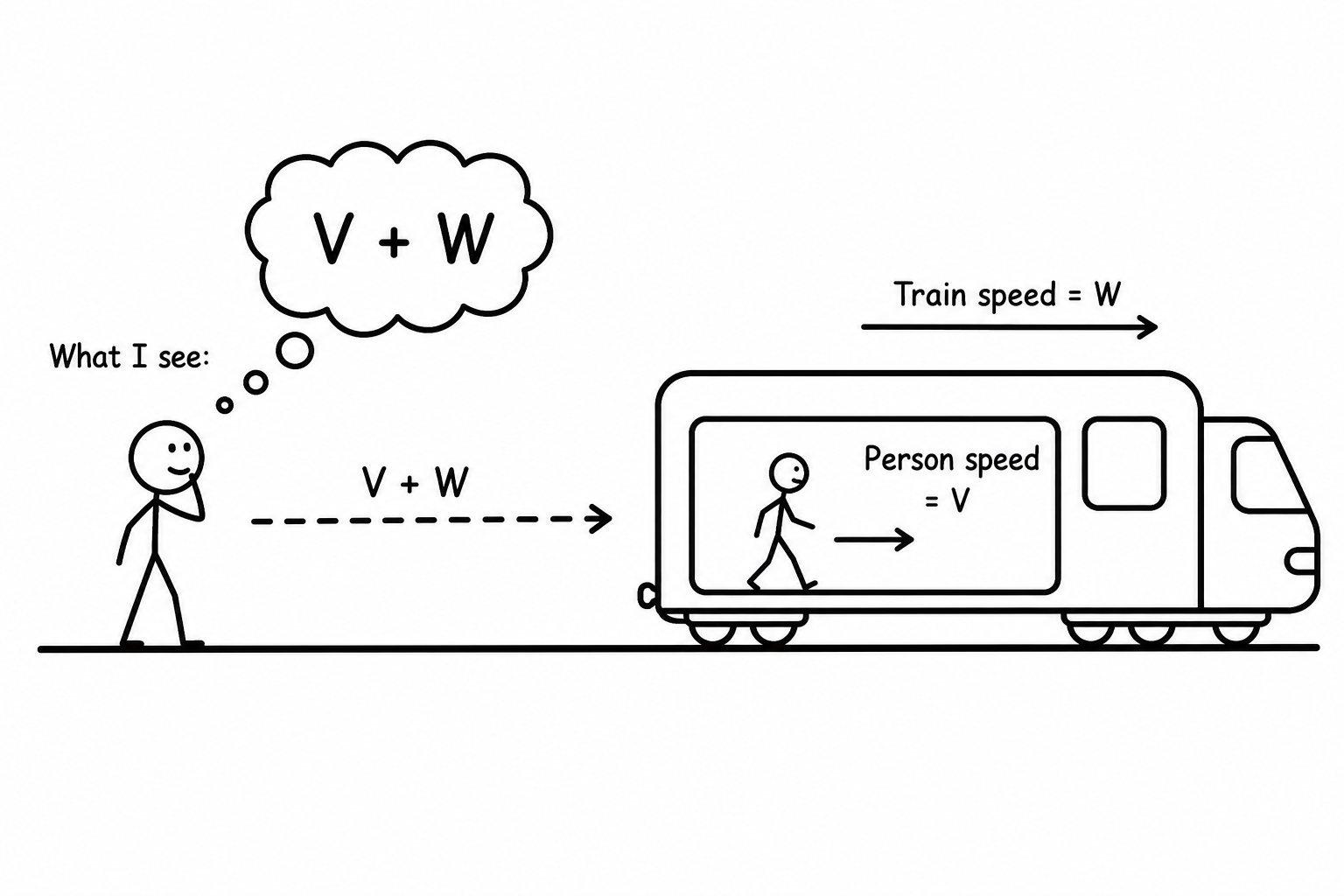
Imagine you are walking inside a moving train in the same direction the train is traveling. Suppose your walking speed is V, while the train moves at speed W.
So what is your total speed?
The answer depends on the observer. Relative to other passengers on the train, your speed is simply V. But to someone standing outside the train, your speed would logically appear to be:
Total speed = V + W
This is how speeds normally work in everyday life. But now comes the strange part.
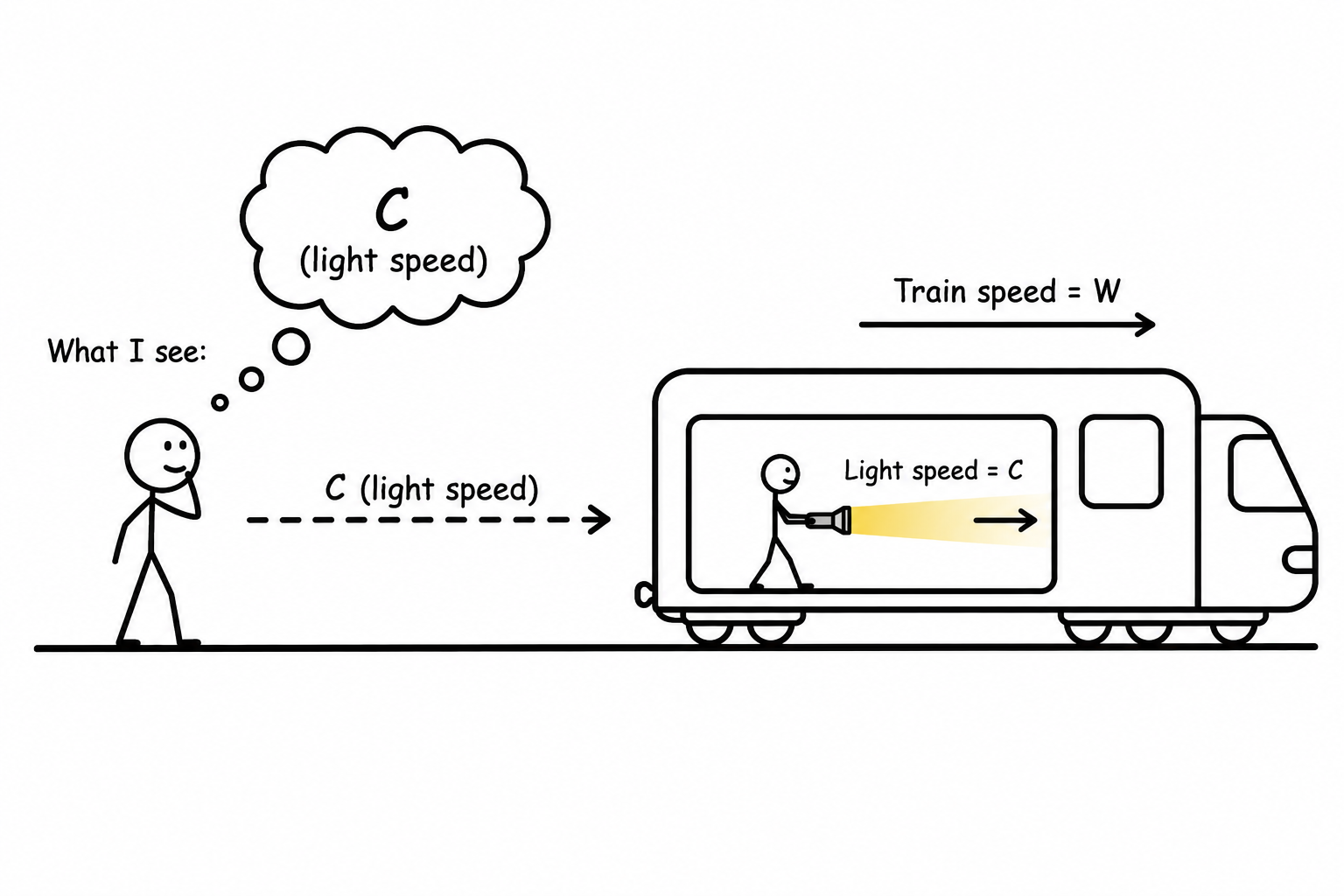
Suppose you stand still inside the moving train and shine a flashlight forward in the same direction the train is moving. Common sense would suggest that an observer outside the train should measure the light moving at:
c + W
Yet this is not what happens.
No matter how fast the train moves, every observer will still measure the speed of light as exactly c.
The speed of light remains constant in every frame of reference. You can move toward light, away from it, or alongside it — light will always appear to travel at the same speed.
This idea became one of the two fundamental postulates of Special Relativity, and it would completely change our understanding of space, time, and reality itself.
Keywords
- Albert Einstein: Albert Einstein (14 March 1879 – 18 April 1955) was a German-born theoretical physicist best known for developing the theory of relativity. Einstein also made important contributions to quantum theory. His mass–energy equivalence formula
E=mc^2, which arises from special relativity has been called “the world’s most famous equation”. - Frame of Reference: A frame of reference in physics is an abstract coordinate system used by an observer to measure the position, velocity, and acceleration of objects.
Images