Special Relativity Part 2: Time Dilation
The faster you move through space, the slower you move through time.
Have you ever wondered is time travel really possible, like in the movies? Surprisingly, according to Albert Einstein and his theory of Special Relativity, travelling into the future may actually be possible. One of the strangest consequences of special relativity is something known as time dilation.
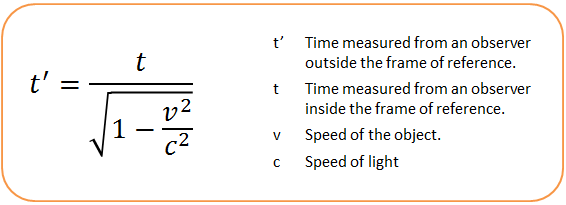
Simply put, a moving clock is observed to tick more slowly compared to a stationary one. At the speeds we normally travel, this effect is far too small for us to notice. But near the speed of light, the effect becomes dramatic.
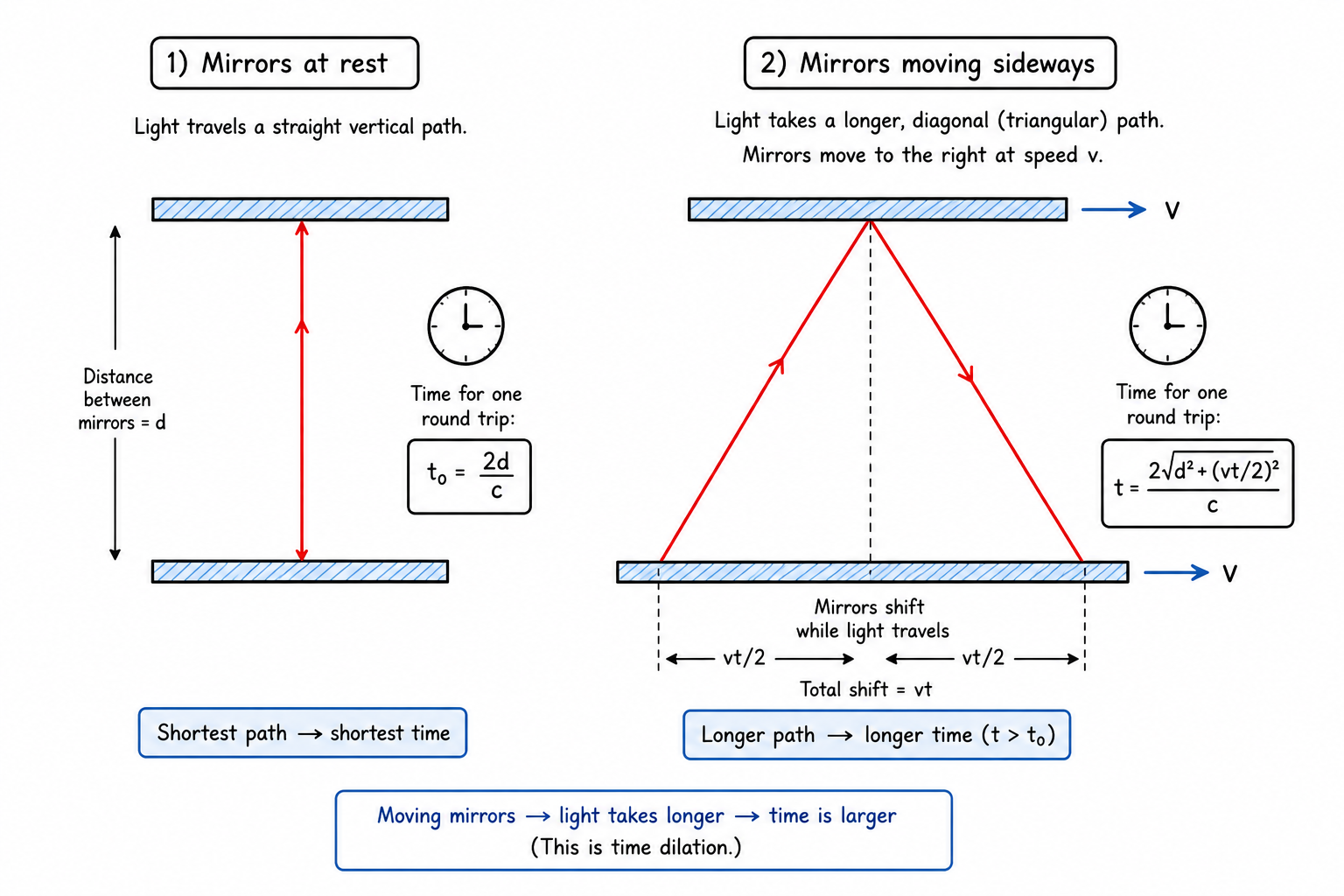
To understand why, imagine a simple “light clock” made from two mirrors, A and B, with a pulse of light bouncing between them.
If the mirrors are stationary, the light simply travels straight up and down between them. Since:
time = distance / speed
the time taken depends on the distance travelled divided by the speed of light.
Now imagine the mirrors moving sideways at a constant speed. To a stationary observer, the light no longer travels straight vertically. Instead, it follows a diagonal path, covering a longer total distance. If we accept that the speed of light always remains constant:
c = 299792458 m/s
then the only thing that can increase is the time taken. The moving clock therefore appears to tick more slowly, we call this time dilation.
And the effect becomes extraordinary near the speed of light. For more context: Imagine traveling away from Earth at 99.94% the speed of light for 5 years, then spending another 5 years returning home. By the time you arrive back on Earth, around 29 years would have passed for everyone else — while you yourself would have aged only 10 years.
In a sense, you would have travelled into the future!
Images