Special Relativity Part 4: Beyond Light Speed
Let’s try going faster
Have you ever wondered, in this vast universe, whether anything can travel faster than the speed of light? In Part 1, we discussed that nothing can travel faster than light. So the universe’s ultimate speed limit is the speed of light… right? Maybe not.
Two of the most intriguing candidates are the expansion of the universe itself and a hypothetical particle known as the tachyon. For now, we will put aside ideas such as teleportation and quantum entanglement, since they do not involve anything physically travelling faster than light.
We know that ever since the Big Bang, the universe has been expanding. Surprisingly, this expansion is not slowing down under gravity as scientists once expected. Instead, the expansion is accelerating. At sufficiently large distances, galaxies can appear to recede from us faster than the speed of light. This does not violate special relativity, however, because it is not the galaxies themselves moving through space faster than light — it is the space between us that is expanding.
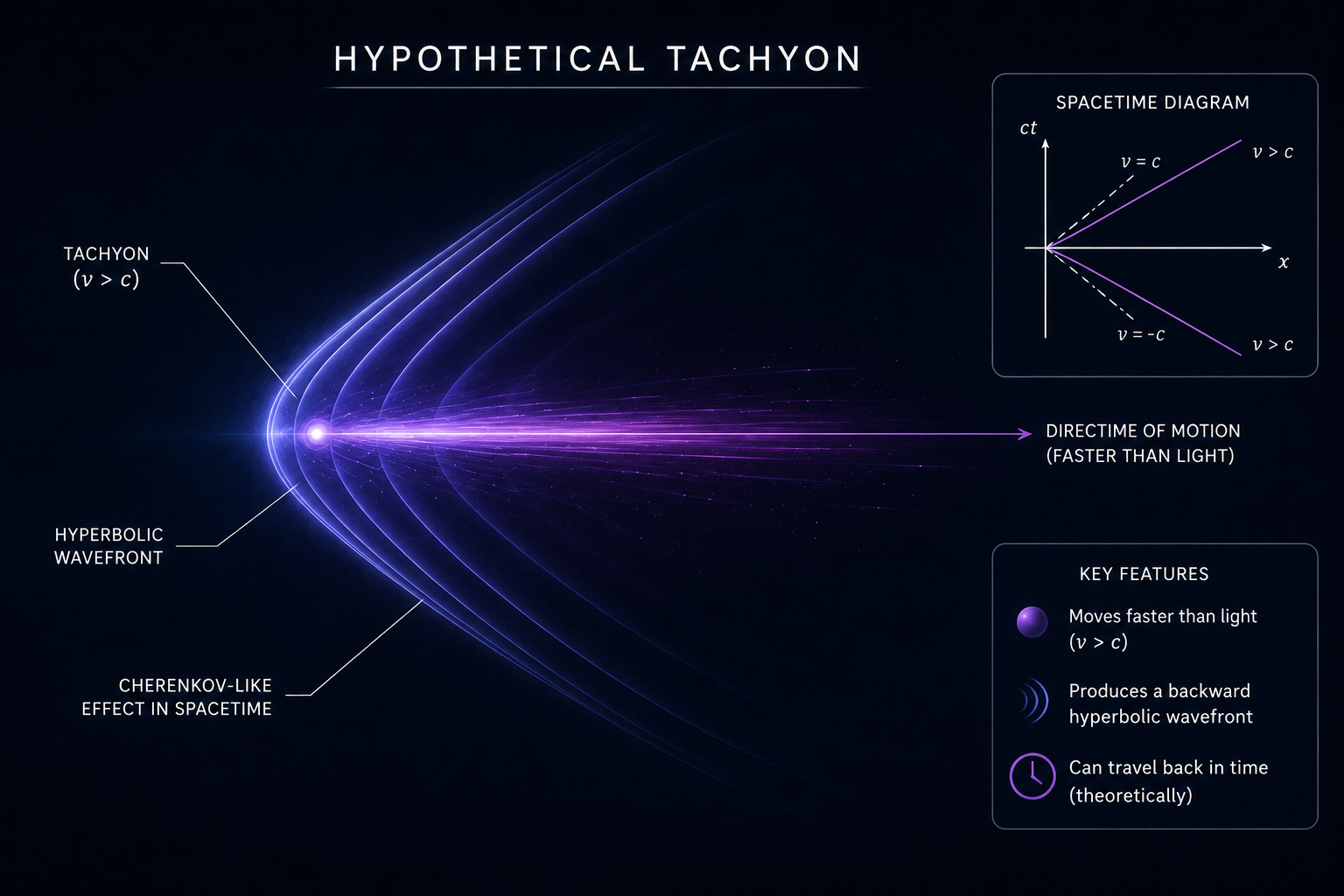
Another fascinating possibility is the tachyon, a hypothetical particle that would always travel faster than light. Unlike ordinary particles, which can never reach the speed of light, a tachyon could never slow down below it. However, no experimental evidence for tachyons has ever been found, and many physicists believe they do not exist.
Why are tachyons so controversial? According to special relativity, faster-than-light travel could lead to violations of causality — situations where an effect is observed before its cause. In some reference frames, a faster-than-light signal could even appear to travel backward in time. Such paradoxes are one of the main reasons why faster-than-light particles remain highly speculative.
So what do you think? Is the speed of light truly the universe’s ultimate speed limit, or are there still surprises waiting to be discovered?
Keywords
- Teleportation: Teleportation is the hypothetical transfer of matter or energy from one point to another without traversing the physical space between them. It is a common subject in science fiction literature and in other popular culture.
- Quantum Entanglement: A phenomenon in which the quantum state of each particle of the group cannot be described independently of the state of the others, including when the particles are separated by a large distance. Measurements of physical properties such as position and spin performed on entangled particles can, in some cases, be found to be perfectly correlated. For example, if a pair of entangled particles is generated such that their total spin is known to be zero, and one particle is found to have clockwise spin on a first axis, then the spin of the other particle, measured on the same axis, is found to be counterclockwise.
- Big Bang: The Big Bang theory is the prevailing cosmological model explaining the existence of the universe from the earliest known periods. The model describes how the universe expanded from an initial state of high density and temperature, and offers a comprehensive explanation for a broad range of observed phenomena.
Images